Showing posts with label apply. Show all posts

Sunday, 5 January 2014

Use the new Principle of Interleaving for solving real life problems


How to apply the new Principle of Interleaving in solving real life problems


Principle of Interleaving

When you apply the principle of interleaving, you put layers of two or more than two types of things (tangible or intangible) one after the other. The relationship between two adjacent layers and all the layers as a whole must result in maximizing utility. 
Between two pieces of bread if we put a layer of tasty things such as a dash of marmalade, a bit of green vegetables and small pieces of meat, we get a result different from just two pieces of bread. A well-made sandwich is tastier than just two pieces of bread.
Here I should admit - I have never closely noticed what things exist inside a sandwich. I imagined a scenario to make a point.
Sandwich concept is the simplest example of interleaving. We may go on increasing the number of loaves in a burger to end up with a giant burger, but each two loaves invariably are separated by a layer of material suitable to be used between the two loaves. You just can’t put anything you like between two loaves to make a tasty burger.
Can you guess why I introduce here such an apparently mundane idea of interleaving and call it a basic principle of problem solving?
The question breaks up into two. It is not a simple question; it is a compound one.
Let us answer the second question first; why I call it a basic principle.

Principles of Cognitive importance enhancement and Abstraction — Concept Structures

All of us are familiar with the idea of interleaving; we encounter it every day. We use coir mattress which increases the utility value of a mattress by putting layers of hard coir and soft foam one after the other (tangible). We recharge our energies by interleaving a hard week of work with a refreshing end of the week trip (intangible). We take care to decide on the items to be served after each item in a multi-course dinner to our important guest. 
You can’t just sequence the serving of food items haphazardly, though technically all food items follow the same path to the same destination. We need to maximize the satisfaction of eating; that is the goal here.
We use the idea of interleaving in lots of situations without explicitly acknowledging that the key idea used is in fact interleaving. By this approach, though we may go on to become an expert in making better and better sandwiches, we may not be able to use the idea of interleaving elsewhere in some other complex problem situation.
As soon as we become aware that we are using an idea called interleaving, the next step is to increase its importance further by naming it as Principle of Interleaving. It then becomes an abstract principle and gains significant importance in your mind as a useful concept that you can use later for solving different kinds of problems.
In other words, by calling it as a principle you help to increase the cognitive importance of the simple taken-for-granted idea of interleaving in your mind.
Your mind is a very powerful entity and you do everything through your mind.
It is our job to think about our mind and take proper care of it. We need to actively consider how to make it happy, how to make it more effective in problem solving and so on. 
When you increase cognitive importance of a useful idea, your belief in its usefulness increases and you become prepared to apply the idea later with more confidence. You add one more resource in your Problem Solving Armory (or PSA in short; we will talk about PSA later). All the basic problem solving principles ingrained in your mind are resources to be used for solving real life problems in different situations. As these are abstract principles it is possible to use these principles in widely varying problem situations. If you knew only about how to use interleaving in preparing burgers, the principle won’t have been so effective. You increase the effectiveness of the principle by abstracting the essence of the idea out of the burger preparation activities. This is what we call the Principle of Abstraction.
I am sure abstraction will be referred to again — it is so basic and important for learning and problem solving. The following shows the concept relationships.

 
Principle of Interleaving

Here the abstract principle of interleaving exists on its own in your mind. In making the burgers you apply the principle in a particular way and in designing the sequence of seminar sessions in another way; but still you do use the same principle of interleaving. That is why the box Interleaving is placed above the four other boxes. Interleaving is an abstract concept that you can apply in not only four but many more situations with suitable modifications.
To summarize, you use abstraction and suitable naming to attach importance to an idea and convert it to a part of your problem solving armory resources.
Without cognitive importance, a piece of knowledge has little usefulness to your mind and consequently to your problem solving activities.
You may ask, what does the above figure represent? What is its name? We may call it as:
The concept structure of principle of interleaving.
By concept structure we mean a set of concepts related together in a structured form. Here the abstract interleaving concept at the first level is suitably modified and applied in the four areas at the second level. The first level concept is more abstract whereas the second level concepts (still interleaving concepts but a little modified for each activity area) are more specific to the activity area.
I believe, all knowledge in our mind reside in the form concept structures. Cleaner and richer the structures, more powerful are the use of the knowledge.
Unordered unrelated unstructured chaotic pieces of knowledge have little usefulness and are a burden to our mind.
We will talk about concept structures again.
Coming back to the two part question, we will take up the answering of the first question now (are we moving randomly?). Why do I talk about interleaving at all?
My intention is not very sinister. I only wanted to hint that shortly (next session at the earliest) we will leave this principled world and enter into a different area of discussion on real life problem solving. Later, when I don’t know now, we will again return to the basic principles of problem solving. That will be Principle of Interleaving at work.
Hopefully this will make these sessions a little less boring (are they really boring?).
Just at the point of leaving today I would like to present you a clutch of cute little problems again.
Problem 1: Choice of a murderer
A murderer is condemned to death. He has to choose between three rooms. The first is full of raging fires, the second is full of assassins with loaded guns, and the third is full of lions that haven't eaten in 3 years. Which room is safest for him?
Problem 2: What was the ancient invention?
Name an ancient invention still in use in most parts of the world today that allows people to see through walls.
Problem 3: Round manhole covers
Why is it better to have round manhole covers than square ones? Have you ever seen any square manhole covers? There may be more than one reason, think of all the reasons. Use principle of exhaustivity.


Read my other blogs on Innovative idea generation and its basic principles and Get smart, get innovative usingTRIZ

Thursday, 2 January 2014

Example showing how to apply principle of exhaustivity in solving real life problems


A detailed example & guideline: applying principle of exhaustivity


Exhaustive thinking guide
We will revisit now the decision making steps to go forward along a more detailed path.
Decisions are made for solving problems. If there is no problem no decision is to be made. These scenarios, where apparently there is no problem and we work following routine action patterns, usually contain hidden problems that are to be discovered, defined and solved. Normally this is a more difficult area of problem solving as the problems remain hidden and are of vague ambiguous nature. Operational areas are of this kind of environments.
A decision is to be made when there is more than one choice. By evaluating the available feasible choices, according to a set of relevant criteria, a proper decision is to be made which will hopefully fulfill some stated objective, that is, in other words, will solve an identified problem.
So a decision problem consists of
·         problem definition that includes goals or objectives of solution,
·         criteria of evaluation of choices, and
·         a set of available choices.
It also consists of the
·         set of actors or the entities comprising of affected parties, stakeholders, decision makers (or DMs), the drivers of problem solution process and the Decision Analysts (or the DAs)
·         equipments and processes,
·         resource constrains, and
·         the domain principles.

A rather routine example showing exhaustive thinking at work: 

I have to go out to the nearby market to purchase a few things and consider the option that it is too short a distance to take my car out. There were two feasible choices. I take one. I take the decision based on my ability to walk the short distance, my available time, my knowledge about how much materials I would purchase and whether the weight of purchased materials would create any discomfort for me while coming back. I compare these efforts with the effort of taking the car out, park it in the market place and also my liking for walking or driving a car.
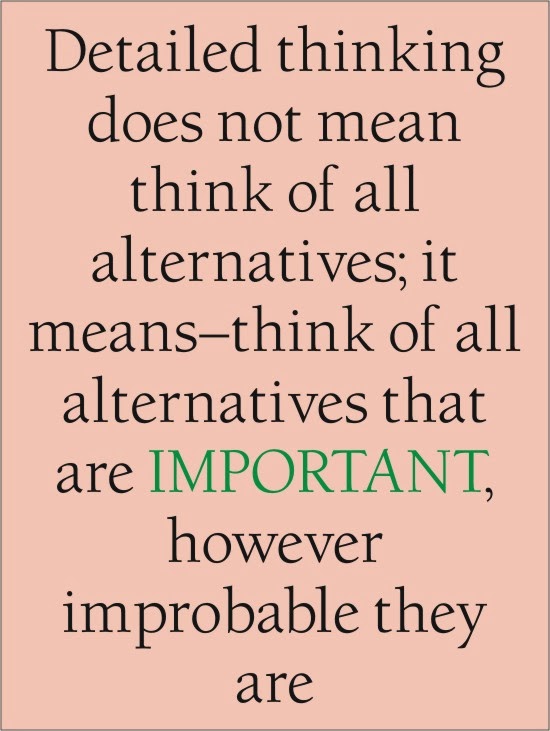
Though it is an everyday activity, do I evaluate all the possible aspects of the decision making? Do I apply the Principle of Exhaustivity in my decision making? Application of this principle is critical for better decision making.
To repeat, Principle of Exhaustivity is applied at various levels. At the very first level, the Decision Maker or the DM must ensure that he is taking all the necessary steps in decision making without missing any. At the very first step, the leading question was did I define my objective precisely? What was it? When I think in precise terms, my objective was to purchase a few specific things, nothing less or nothing more. This is where I apply the Principle of Precision (in precisely defining the objective I must also apply the principle of exhaustivity).
I must have my objective precisely defined, my choices precisely spelled out and also the evaluation criteria precisely enumerated. Vagueness or ambiguity in any of the three will result in a confused situation where satisfactory decision making would be hindered.
When I knew about my objective, at the second level of exhaustive enumeration, I must again enumerate all the feasible course of actions or choices that may meet my immediate objective. The leading question in this case was, from where to make the purchases? In this case the choices were, to go to the nearby market or go to a shopping mall that is located a bit farther away. 
I am still at the second level of exhaustive enumeration of all the choices at that stage. From my experience, I knew that I would get the things that I wanted to purchase from the nearby market also (of course I will get them in the mall). So I decide at this stage that I would go to the nearby market. This is an intermediate decision. In a decision making scenario, there may be series of decision making stages with options and choice of an option at every stage.
This decision gives rise to the leading question, how to go to the nearby market? At every stage of decision making, these leading questions help to generate further courses of action. Again I think about all the possible ways of going to the nearby market exhaustively and decide that there are two alternatives, going to the market walking or taking my car out.
Now I have arrived at the final decision making stage, and am faced with the leading question, what are the criteria based on which I will choose one of the alternatives? Here I apply the Principle of Exhaustivity again. This is the third level of its application, namely to enumerate all the important criteria for evaluation of the feasible alternatives. What can be the criteria?

The exhaustive set of criteria I decide upon consists of,
·         The time available to me for making the purchase
·         The weight or ease of carrying the purchased materials
·         My energy level at that point of time
·         The distance of the nearby market from my home,
·         The condition of the road to the market,
·         The effort in taking the car out and driving
·         The ease of parking the car in the marketplace, and
·         My general preference for walking or driving a car.

I tried to apply the exhaustivity principle as thoroughly as possible. At this point of time, I had the three essential ingredients of the Decision Model—the precise objective, the exhaustive set of feasible choices and also the exhaustive set of important criteria for evaluation of the choices. These set of activities form what we call the Decision Making Model or the Problem Solution Model.


Here the criteria are mostly qualitative and evaluation of the choices would necessarily be based on my judgment. But instead of using judgment in an ad-hoc manner, there is a possibility of applying quite mature and mathematically sound scientific methods to deal with this kind of model (we will discuss such a method later).
In our personal lives we do not like to use such formalisms. I also avoided it and using my judgments I decided to go the market walking.
That was my final decision to meet my goal. But still my approach was inherently scientific because by nature I have learned to apply the Principle of Exhaustivity in all the steps of decision making. This approach itself gives rise to clearly understood objectives and decision making reasons that result in satisfactory and explainable outcomes.
Let us go now back again to the situation where I was at the point of going to the nearby market without taking my car.
When I went out of my door, I noticed an accumulation of dark clouds on the northwest corner of the sky. 
Question: What could be my thinking and actions? How would the criteria or the choice of actions change?
Though it will vary from person to person, but a few things can be spelled out with a fair amount of certainty.
a.    I will immediately think whether the rains will come. But I will assess the possibility of rains coming before I can return back home. So only rains coming is not my assessment target, by when the rains will come is the precise assessment target. This is the precise definition of this decision making step.
b.    I will then actually assess the possibility (not probability, we do not think in terms of probabilities in real life) of rains coming before I return home. This assessment I do by exercising my judgment on the situation basing on my experience.
c.    I assess that rains most probably won’t come before I return home. But still I do not discount the possibility of rains altogether and consider taking my umbrella with me.
d.    Here again I apply specific reasoning. I knew from my experience that in this season the rains are usually associated with high wind and I know in fierce wind umbrella won’t be of any practical use.
e.    Still I had the options of taking my car or waiting out the rains. I applied my judgment that waiting out the rains will waste my time. So I decide to go out. And I also knew that if at all the rains come, I can take shelter on the way and wait for some time.
f.     Thus finally I decide to go out and go out without my umbrella. But on the way I hurry along and my shopping also I complete decisively and quickly to beat the rains. The knowledge that the rains might come quickened my actions. In any case I thought, if the rains come, a little wetting with a light packaged purchase won’t hurt me much.
In this case, if you have noticed, I have considered nearly all associated aspects, made judgments about uncertain events based on my previous experience and took decisions according to my judgments and also my preferences or likings (I didn’t like taking out my car unless it is necessary, and similarly I preferred to go out without umbrella as far as possible). I tried to be as exhaustive as possible and as precise as possible in defining the problems and sub-problems.
Thus, in addition to the interminable Principle of Exhaustivity we have come to know a new ordinary looking principle, namely—the principle of precision.

Do practice knowing and applying the abstract principles


These are abstract principles and so can be applied in solving problem of different domains, not just one domain. This is the strong-point of being abstract. The more abstract a concept or principle is, the more its power. The fundamental concept of Abstraction we will take up later.
An important point I need to remind you before I part with you now:
·         Just like you need to practice hard to become a good athlete, or a good singer or a renowned writer, there is no other way for you than to practice with reasonable seriousness towards the goal of becoming a Real life problem solver. It is easy for me to tell you about the importance of the principle of exhaustivity, but this recommendation will have no value to you unless you experience its value yourself and bind it into your mental problem solving framework.
Do practice. Go on doing practice. Of course if you are serious about it.
Okay we have had enough. Let us say bye now. But before you go, solve the second cute little problem in any way you like. Try to think using systematic and exhaustive reasoning, though this problem originally demanded out-of-the-box thinking.

Problem 1:

There is a man who lives on the top floor of a very tall building. Every day he gets the elevator down to the ground floor to leave the building to go to work. Upon returning from work though, he can only travel half way up in the lift and has to walk the rest of the way unless it's raining! Why?


Read my other blogs on Innovative idea generation and its basic principles and Get smart, get innovative usingTRIZ