Showing posts with label concept. Show all posts

Monday, 27 January 2014

Special personal problem solving techniques

Problem solving concept structures: Special personal processes - Memory techniques

Abstraction and summarization much improves understanding and remembering concepts
Use of indexed memory

Process is a series of steps with a purpose. It is obviously more complex a concept structure than either a rule or a rule set. Routinely we follow many processes. The process of brushing the teeth, placating an angry spouse, handling happy new year - all are routine processes however frequent or infrequent these may be. But occasionally, you may discover by accident a process that helps you to come out of a tight spot. 

This special process you remember because it helped you in solving a difficult problem. We call this type of process as a special personal process of problem solving kind. 
This then acts as an additional resource in your Problem Solving Armory resources. In future whenever you encounter the same problem context, you recall the effectiveness of the process you had used in the past to solve the seemingly unsolvable problem and use it again to solve your problem. With repeated successful use, belief on the process increases as well as its refinement.
We will now go through an example.

Story of a trick to remember a name

I became quite confused when it happened the first time. I was about to make an urgent call to a person on my mobile. Just when I was going to start dialing, I found that I couldn't remember the name of the person at all. In confusion I tried hard to remember the name. I knew the call was important and it was in my own interest. But however much I tried, the desired name remained elusive. In today's world nobody remembers the mobile numbers of contacts in address book, one searches in the address book by the name of the person to be called, and then makes the call.
Unless I remember the name of the person I needed to call, I will miss something important. Even that I couldn't remember - the purpose of making the call.

Then it occurred to me, why not start from the first letter A in the alphabet and consider for a few second, whether I can remember the name in case it starts with letter A. If the first letter fails to produce a result, try the method on the second letter B. I carried on this way till suddenly, while on a particular letter, like a flash I remembered the desired name. Surely the name began with the particular letter. Oh yes, this is the name I wanted to remember -I said silently and completed my urgent call. I may have a bad memory, but still I survived due to an unusual process that came to my aid.

Once is not enough for you to believe the applicability of a new process. When you get the opportunity to use a special process again, you reuse it to test its sustainability.

In subsequent years I had used this special technique many times and it never failed to give me desired result.

Repeated successful use of this special process finally made me a firm believer of the process

Now It is ingrained in my mental problem solving framework.

For some days my surprise lingered on - how the process really worked! Then I started analyzing. My conclusion was: "the names in my address book must have been indexed in my memory." That was the first time I got an idea of how contents are organized in our memory. 
Indexes are small snippets or codes representing a particular piece of content. While storing a content in the memory its index also to be formed. Searching the memory must be on indexes. After selecting a particular index, its corresponding content is fetched to the upper memory for use. In simple terms, this is my visualization of how memory works. 

Technique of Summarization

When I was a student, after finishing the preparation of a subject paper just before the exam, I used to write a summary of important relevant points in the subject. This way I attempted to capture the whole subject in my mind, but in compressed form. While answering the questions during the exam, I found it very easy to recall the right answer to a question. I felt quite comfortable and confident as far as memorization of the content was concerned. I have a firm belief that just this process of writing the summary points made recall so easy. Later when I came to know about indexing mechanism, my understanding got a firmer support. 

Still later after going through the book Future Shock by Alvin Toffler, I set out to summarize its contents in handwritten four pages. Those four pages contained the gist of the whole book and going through the summary later was nearly like the experience of reading the whole book for me. That was also an Index.

If you know that your memory works on indexes, you may resort to creation and use of different types of external indexes. Summarization forms one such type. 

Abstracts though seem to be similar to Summarization, lack the point by point details of Summarization. Abstract is usually smaller than summaries. Though an abstract gives an idea about a piece of information, it does not usually contain enough information for use as a recall mechanism for the whole piece.

Finally, to sum-up this three post series on special concept structures:
Personal Rules, Rule-sets and Special processes are all classified as special concept structures and form a highly useful set of problem solving armory resources.  Also we are fairly certain that our memory works on indexes. Accordingly we can create and use various types of short form indexes of main matter for easy recall and effective use.

Read my other blogs on Innovative idea generation and its basic principles and Get smart, get innovative usingTRIZ

Saturday, 11 January 2014

Deeper logic analysis - an useful ability for Innovation and Real life Problem Solving

Compound logic analysis techniques


Power of Logic

Logic analysis primarily deals with yes/no variables or questions. The core concept of this approach of limiting the number of final possible outcomes to only two makes this world of yes/no a certain world. To understand the power of this on/off or yes/no world, you just have to consider that the whole of the digital world is built upon the foundation of two valued Boolean variables. We have achieved, amongst many other great gains, a tremendous leap in accuracy in the digital world compared to the analogue world where a continuously changing parameter can have any number of possible values in a continuum.
Thus excited with the digital world of yes/no logic, one might be tempted to assume that answers to all earthly questions can be obtained using pure logic.
Unfortunately, most of the important factors in real life decision making do not adhere to only two possibilities and thus cannot be analyzed or predicted using pure logic. For real life problem solving, one needs to use whatever resources are suitable and available. Till now we were exposed to:
A few basic principles of problem solving, namely,
*      Principle of exhaustivity
*    Principle of precise definition
*    Principle of interleaving
*    Principle of zero based problem solving
A few inventive principles of TRIZ, namely,
*   Principle of segmentation or breaking down a larger piece into smaller pieces
*   Principle of merging or combining similar type of smaller pieces into a larger one
A few powerful techniques of problem solving, namely,
*      Pattern identification
*    Enumeration
*    Abstraction (though abstraction is more than a technique, we may classify it as a principle itself)
*    Structuring
*   Induction principle (we classify this as a technique because of its less power and abstraction)
*      Domain mapping (we have actually used the concept of divisibility and factorization in Mathematics domain to answer the third question in the area dividing sub-domain encountered in the four square problem)
*    Logic analysis
We were also exposed to Concept structure as a problem solving resource.
Additionally, we define now Deductive Reasoning as the overall chaining mechanism that binds all the fact gathering, analyses, and decisions from start to end step of a problem solving process.
Logic analysis is only one of the problem solving resources.  
In spite of logic analysis being only one of the problem solving resources, the core concept of yes/no can be used for creating a few other powerful problem solving tools and techniques. We will be exposed to these later.
Let us now delve a little deeper into this interesting area of logic analysis and solve a more complicated logic problem.
Problem 1: Which path would you take? (version 2)
A logician while visiting the South Seas again is at a fork. He needed to know which of the two paths in front of him leads to the village. In this case, he has three willing natives available nearby. But one of them is from a tribe of invariable truth-tellers, another from a tribe of invariable liars and the third from a tribe of random answerer. The logician knows this but does not know which one is the liar, the truth-teller or the random answerer. The natives though know each other well. The logician can ask only two yes-no questions each directed to just one of the natives. Can he know the right path to the village?
Very hard? Well, it seems to be so in the beginning. But remember one golden principle: however difficult and complex a problem seems to be in the beginning, it is bound to get simpler if you can break it up intelligently into smaller pieces. This is called Fragmentation or Problem breakdown principle.
With this hint of a golden principle we will leave you to solve this problem yourself. You can take an hour if you wish, but please do make a serious attempt to solve this problem. Use your deductive reasoning. Analyze and formulate inviolable conclusions.


Solution: Can you break up this problem into two smaller problems? Yes you can. If you observe closely, you will find that the last question situation must exactly be like the version 1 of the problem, that is, one question, two alternatives and two natives (or one native)– the liar and (or) the truth teller left. This is because, at the last stage, if the random answerer is left and you put the common question to the random answerer his answer may be yes or no, whereas at the last stage you must get one specific answer to your specific common question. Thus the problem is transformed and reduced to the form,
First question, three natives, objective: eliminate the random answerer.
Notice that here also you have used your deductive reasoning capability.
How can you meet the objective of eliminating the random answerer at the first step?
Consider: in the second question, you have to ask the question involving the right path, otherwise you won’t be able to know the right path; that is a certainty. In the case of the first question would you ask about the right path? Is it reasonable? It is not. Instead you must ask about the answering nature of the natives.  You will form the question in such a way that when you ask the second question the troublesome and unpredictable random answerer is no longer there.
What should be the first question?
Asking a native about his own nature will not lead you anywhere. So you must ask a native about the nature of the other two natives.
What can be the type of question?
A new technique is to be used: pair-wise comparison is a powerful technique for reliable comparison.
Let us now use the technique of enumeration. We assume scenarios of nature of the natives and then analyze the possibilities arising in each scenario.
Comparison regarding reliability of answer: Truth teller vs. random answerer: What conclusion can you draw?
Truth teller answers truthfully all the time, whereas random answerer answers truthfully 50% of the time. So, Truth teller is more likely to answer truthfully compared to the random answerer. Oh yes, the phrase “More likely” is the key. This is Testing & information discovery. With this knowledge now we would enumerate the scenarios and continue our analysis.
Scenario 1: You ask the first question regarding reliability of answer to the liar (C) comparing the answering nature of the truth teller (A) and the random answerer (B). This is a clear application of Enumeration.
In this specific case, the liar will answer NO, but if nature of A and B are reversed, answer will be YES.
This knowledge leads to the decision: If the answer to the first question regarding comparing the answering nature of two other natives is NO, ask the second question to A, if it is YES ask the second question to B (in both cases you will then ask the second question to the truth teller, eliminating the random answerer).
Scenario 2: Comparison between Liar (A) and random answerer (B). Question to C, the truth teller.
In this specific case, true answer is NO (Liar A is not more likely to answer truthfully than random answerer B), and as C is truth teller his answer will still be NO. If nature of A and B are reversed, answer will be YES.
This result leads you to the decision: If this answer is NO, ask the second question to A, if it is YES, ask the second question to B (in both cases you will then ask the second question to the liar, thus eliminating the random answerer).
What a surprise! In both the scenarios you have asked the same question and got the same desired outcome. In the desired outcome, either liar or the truth teller is left for facing the already known second question. Random answerer is eliminated.
You now ask the question of version 1 of the problem to any one of truth teller or liar left and will surely come to know the right path (as per version 1 of problem). But what if the first question goes to the random answer, marked here as C?
Scenario 3: If the first question goes to C, the random answerer, B and C are either the liar or the truth teller and your promising first question still holds right. That simple!
Let us now analyze your problem solving process. Remember: solving a problem is not enough; to understand and reuse the process of solution, you must analyze and clarify the problem solving process.
Analysis of problem solving process:
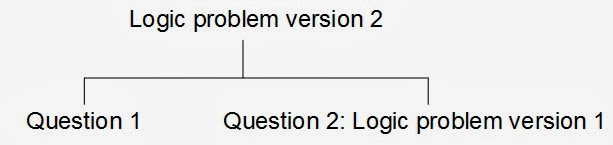
First you have used problem breakdown principle identifying that when the second question is asked, the situation must be similar to version 1 of the problem for you to get the right answer. This is somewhat like the figure below.


Note that, as you already know how to solve the version 1 of the problem, it has become easier for you to solve the problem version 2. What exactly did you know about the version 1 problem? You knew the problem description, problem modelling and process of reaching the solution. In short you have in your mind the concept structure for the version 1 of the problem. This is a clear example of using a concept structure in which you have used the concept structure of problem version 1 in solving the problem version 2.
What is the use of a concept structure in general? All knowledge is held in our mind in the form of concepts that are linked together in the form of concept structures. There are various forms of structures that we can use for representing the relationships between the concepts in a problem.
To formulate the first question then, you have used the techniques of Testing & Information discovery. You have discovered “more likely” as the key phrase in your first question.
Now is the time of enumeration. You have enumerated two scenarios and homed into the same promising form of question and action plan related to the answer.
Can you form the final form of the first question now?
I will leave you here to the pleasant experience of reaching the solution at last, after the seemingly interminable collection of statements.

Read my other blogs on Innovative idea generation and its basic principles and Get smart, get innovative usingTRIZ

Tuesday, 7 January 2014

Introducing the new powerful technique of zero-based problem solving


The new powerful technique of zero-based problem solving


Zero based solving

We tend to start a problem solving process with previous biases. Admitting that we can’t be totally free of biases, it is of great importance to start a new problem solving process from as much neutral a standpoint as possible. It will enable me the problem solver to analyze the new problem in its own merit. After this analysis, if need be, old known techniques, methods, principles and approaches I will use just as it is required to be used for solving the specific problem.
At the very beginning, before analyzing the problem well, I should have no opinion regarding how I will go about solving this problem.
I will start with a clean slate, a zero base and an alert and bias-free analytical mind, prepared for anything. As I proceed towards the solution step by step, gradually I will start forming rules and patterns that I think will be effective in solving this specific problem.
This is what I call the Principle of zero based Problem Solving.  
We know what is zero based budgeting and some of us have heard about zero based thinking. Here we have used the abstract idea of zero based approach in problem solving to form a useful principle. The important concept here is the idea of zero based approach. It simply means, start fresh.
It is a powerful approach and can be used in situations in our lives when we are in dumps, want to forget the past but cannot escape remembering.
The link below possibly contains some useful insights:
Now we will discuss solution to our Four Square Problem. I hope you have solved it already.


Learning from solving Four Square Problem


Problem restatement:

Question 1: Divide the light grey unshaded area in square A into two equal pieces.
Question 2: Divide the light grey unshaded area in square B into three equal pieces.
Question 3: Divide the light grey unshaded area in square C into four equal pieces.
Question 4: Divide the light grey unshaded area in square D into seven equal pieces.


The original square is shown below for convenience.


Answers to the first two questions are easy.


The red diagonal line divides the unshaded area in square A into two equal pieces and it is immediately visible to you.

While looking for the second answer, you perhaps imagined or visualized the empty area as a collection of three equal squares. Basically in this case, you have imagined square B in terms of a square made up of four smaller squares. For this answer you didn’t have to wait long. By visual inspection, the answer comes easily.
Perhaps the third question gave you some trouble. At least it gave me a little trouble. By previous bias I tried to think square C as a square made up of four squares – no, that won’t do – within a few seconds I found this. Basically the unshaded portion here consists of three equal squares. We need to divide it into four equal pieces.
How can we divide a three unit piece into four equal pieces?
Can we break down each part of the three part piece into four smaller parts? If we do that we will get 3x4, that is, 12 smaller parts. These parts are equal squares. Oh yes, we have got the solution now. Take three such adjacent squares each. Do it suitably three times and you will get your solution (when you do three, the fourth will automatically be created). The breakdown of the three small squares is shown below.


 And now the final solution.


I don’t know how you have got the solution, but if you look at this method, don’t you feel this is a more sure and systematic way of solving at least this problem?

Which principles did we use? In the question 2, we straightway divided the empty space into three equal parts. That method we can’t follow here we have tried and found out. This learning was through analysis and application of Principle of Fresh Start.

This step of problem analysis is vital in learning the nature and anatomy of the problem. At this step we have also discovered that we need to divide a three unit area into four equal pieces.

As we are not using any fraction concept here, the new derived requirement implies that we need to breakup each of the three units into four equal smaller units. Do you find any similarity of this concept with anything you know? Think over.

As soon as we know what is needed to be done, we examine the smaller squares, and decide that it is easy to break each up into four still smaller squares ending up with 12 small squares.

Now it is easy for us to get to the final solution. First we combine three squares together four times to get four collections each containing three equal squares. And last but not the least: you need to actually implement this abstract solution, which is in your mind, into the physical square domain.

Does it remind you of any school level knowledge? Remember the concepts of divisibility and factorization. This is nothing but application of those early basic concepts into another domain.

This is beauty of using abstract principles and concepts in problem solving. A school level basic concept you have now used for solving an entirely different kind of problem. Here division of space was the core activity and required ability.

In the same way, in future if your MPSF finds some similarity in a different problem situation, it will recommend use of this abstract principle and will lead you to the solution.

By the way, can you say which is the abstract principle we are talking about? Give it a thought.

We have used two highly powerful principles here:
*      First we have used: Principle of Segmentation (or dividing or fragmenting), and
*      Next we have used: Principle of Merging (or combining similar things).

These are two of the leading principles in the set 40 inventive principles of TRIZ which we will discuss in later sessions. These principles have very wide applications.
Let us come back to the four square problem again. First we finish answering the fourth question.
What was your experience in answering the fourth question?  Either you know the answer instantly or you find it difficult. If you get the solution instantly, you have used your intuition. Intuition is also a powerful mechanism towards problem solving, no second thoughts about it. Intuitive problem solving is fastest.

In emergent situations such as fire-fighting, front-line battle in a war split second decision making is the necessity and that kind of decision making is mostly intuitive based on experience and training.
Unfortunately for me, I was stalled for about 10 seconds trying to segment the totally empty square D using complex methods I had used in question 3. That was bias. This is one example of the need to start fresh without any bias. The more you move along the earlier path, farther away will you move from the solution. 

In about 10 seconds I recognized my mistake and started to think fresh from a zero base. It became immediately apparent that I can divide the fully empty square into any number of equal pieces by just dividing one of its sides into equal portions by drawing side length lines parallel to its perpendicular sides.
This is another kind of segmentation. It is segmentation, but used differently. You are segmenting a space by segmenting a length.
This is more versatile, as by applying this concept you can actually divide the square into any number of equal portions. We say application of this concept here is more general in scope.

Now notice how we have used the same concept of Segmentation in four different ways to answer the four different questions. In the first question we have used simple observation. In the second question, we have mentally broken up the space into three equal pieces straightaway at the first attempt itself. To answer the third question we faced some difficulty, but finally we reached the solution by first segmenting the squares into still smaller squares and then merging them into required number of collections. In the fourth question we have not used any of these techniques but took resort to segmenting a side to segment a space.
Before anything let us see the fourth solution.


Concepts and Concept structures

How to segment is an abstract concept. We may think of this as a standalone concept. It can briefly be described as: a process of dividing something into smaller pieces of same something.
This process of segmentation can be applied on practically any physical thing that can be segmented without breaking it and destroying its property. But before going down to a physical object we might discover that the characteristics or properties of physical things form an abstract concept layer higher than the physical things but below the concept of segmentation.
What are the physical characteristics on which segmentation principle can be applied? What did we segment here? We segmented space in the four square problem. From a general abstract concept of dividing into smaller pieces we became more specific and learned how to divide space into smaller pieces. The four different questions led to four different ways to segment space. Each of the ways forms a specific variation of the concept of segmentation.

The following shows the relationships between various layers of the concept segmentation in the form of a structure.

Concept structure of segmentation - in four square problem solving


But in addition to Space, we may further consider applying the concept of segmentation to Distance (divide a distance in kilometers), Time (divide a day into hours), or Weight (divide a quantity of sugar into kilograms).
We segment many characteristics of tangible or intangible things during our daily lives. Think of some examples.
How do we segment? In many cases we have units and measuring instruments that help us in segmenting, but in many other scenarios, we need to use our estimation.
For example, we may need to answer the following questions with respect to an empty room.


*      How many students can be accommodated in this room if used as a lecture room?
*      How many workstations can be put here to form a computer lab?
*      How many office desks can be placed in this room if used as an office room?


To answer these questions, we need to estimate space requirement for students, workstations and office desks with sitting chairs respectively. For each we will use the concept of space segmentation, but suitably modified according to the problem. Carrying out the actual segmentation, we need to estimate, each a different type of estimation.
Thus from the abstract concept of segmentation we become more and more specialized and specific in segmenting as depth of level increases. Following is a representative concept structure.

Versatile Concept Structure of Segmentation


This is a vertical segmentation starting with the abstract concept or principle Segmentation at the Level 0. At the next level 1 we become more specific with the idea of Segmenting Space. It could have been, Segmenting Time or Distance as well at this stage depending on the problem model. At the next level 2, we become still more specific with the concepts of Segmenting an office room, a class room or Segmenting a lab room depending again on the problem definition at hand. If I know how to segment Space, with a little more thought I should be able to segment any kind of space. I would need the capability of estimation to effectively do that.
This is what we call Structure, rather a hierarchical structure. We will just state here that Structures are the skeletons that hold all knowledge. It is sufficient to know here that clearly defined concepts and their inter-relationships form a structure. When solving a problem, the very first thing that you may do is to form a problem model in the form of a structure. It may not be explicitly drawn on paper, but nevertheless forming such a structure in your mind makes the problem solving much easier.
Interestingly, most real life problems are inherently ill-structured. It depends on the problem solver to create some kind of structure of the problem after due analysis of the problem.

Isolated concepts are of little value

When we start learning about a concept, we may learn bits and pieces of it in the form of concept components. At the very start, these constituent concept components may not have many relationship links between them. At this stage of unrelated concept components, we cannot use the components well. Once we start relating the components and gradually establish a structure (it may be hierarchical or a network or of other forms), it becomes highly effective and usable knowledge. This form of inter-related concept structure makes retrieving the whole structure from memory and using it effectively much easier. Load on your memory decreases as well as power of knowledge increases.
Cramming facts about a subject creates unrelated pieces of concepts of little overall value, whereas well structured and connected concept structures represent effective and usable knowledge.

Why are these ideas on concept structures important for our purpose?

The reason we are discussing concept structures at length is: to solve real life problems of any new type, not only you have to use well-formed already existing concept structures in your mind, but also you have to create such structures by analyzing the new problem and only then you will have proper control on the problem.
Building powerful and effective concept structures is a continuous process and this process speeds up if you are aware of existence and importance of such structures.
Look where we had started and where we have finally landed. This is again a process. We call it Idea linking and Exploration. We discover new areas of knowledge and new possibilities by consciously using idea linking and exploring and Problem solving needs continuous learning and exploration.


Read my other blogs on Innovative idea generation and its basic principles and Get smart, get innovative usingTRIZ