Showing posts with label technique. Show all posts

Sunday, 12 January 2014

Working backwards – a powerful technique of Problem Solving

Some problems are best tackled with working backwards approach

Working backwards approach

Usually when a person starts solving a problem, she approaches the problem from the start point and takes the first step in the form of her first decision. If she is a cool customer, she stops, evaluates and then only takes the second step. This way she moves from beginning to end of the problem. The desired end of the problem is of course the goal or objective or the solution.
Interestingly, even for mathematical problems, there is sometimes more than one way to reach a solution. For real life problems possibility of multiple paths to solution is more. Not all the paths to the solution though, just like life, are of same quality. Quality of solution can be measured in terms of path traversing time, difficulty and other such costs.
You know, to get something you have to give something. Those are trade-offs. You may follow any path to reach what you think is the solution to a problem, but you may not achieve desired efficiency of solving effort as well as desired quality of solution.
We will always recommend you elegant paths of problem solving. Problem solver's approach will enable you take the elegant path to the desired solution.
Today we will expose you to this aspect of problem solving using a mathematical problem.

Problem 1: Cute little aquarium fishes – how many albino angels did Paroma have to start with?

Paroma has a hobby of culturing aquarium fishes for a number of years. She spawns different varieties of attractive aquarium fishes and sells them to selected customers. Last Monday she evaluated her aquarium situation and decided not to have albino angels at all. Accordingly she first sold half of her albino angels and half an albino angel to Novelty House. Next she could sell half of her remaining albino angels and half an albino angel to Hobby Centre. She found that she had 3 albino angels left. She thought it would be much better to gift these 3 albino angels to her best friend Sohini than to sell them. They were too few for a good sale. It was a good decision and Sohini was actually very elated when she got the three beautiful albino angels as a gift from Paroma.

How many albino angels Paroma had to start with?

Restriction: You can’t use algebra here. That is mathematics. You have to solve the problem as a problem solver using deductive reasoning and at most addition subtraction type of basic mathematical operations.
Think for at least half an hour. Don’t give up. It is an important problem. If you find the elegant solution yourself, not only will you be very happy, but more importantly, the learning will go deep in your problem solving mindset which we call as MPSF (abbreviation of the awkward name of Mental Problem Solving Framework). In simple words, you will learn better.
We will now take a break for you to solve the problem before we return again to discuss the solution and the elegant path to the solution.
By the way, it is not a trick problem at all. It is a very honest kind of problem.


Solution: When you go through the problem, you recognize two barriers to reaching the solution – first: you need to resolve the barrier of half an albino angel; and second: of course you have to reach the solution. Unless you get across the first barrier you can’t proceed to solve the problem at all.
What could the phrase, “half an albino angel” mean? You just can’t cut a living thing into two halves and sell it. Can you? Then you notice that this phrase does not come alone, it is used on two occasions, invariably with the phrases, “half of her albino angels” or “half of her remaining albino angels”.
What can you deduce from this observation?
Given that you can’t cut an albino angel into two halves, your new observation can only mean that halving “her albino angels” or “her remaining albino angels” didn’t result in a whole number and so to get a whole number another virtual “half an albino angel” had to be sold.
This is a problem in the number domain, and being sufficiently educated you immediately understand the root cause of this problem – “her albino angels” and “her remaining albino angels” must have been odd numbers.

This is a key information discovery by the use of deductive reasoning (which includes a bit of mathematical knowledge).

Thus overcoming the first barrier, you continue thinking like a problem solver and decide that you have only one number known, that is, the number of albino angels that were left after two sales. It is 3. You do not have anything else to start your problem solving journey with.
So you decide to start with this end result of 3 numbers of albino angels.
What should you do next? You decide that it would be promising to take the first step as: undo the last sale. Now you are working from back to front. Just imagine how you are moving now along the problem solution path.
The last action of the last sale was to sell half an albino angel. To undo this, you add half an albino angel to the remaining 3 to get 3.5 numbers of albino angels. Next you undo the second action (you are moving from back to front and so, this is the second action to you; while moving forwards it would be the first action of the last sale). The action is: sale of half of her remaining albino angels. To undo, you get back this number which must be equal to what you have now, that is 3.5. Getting back the same number means adding the same number which in turn means doubling the number 3.5. As a result you get 7.
What does this 7 represent? This is the number of albino angels Paroma had after her first sale.
Repeat the same process once more: add half to 7 and then double the result. Oh yes, Paroma had 15 albino angels to start with.
At this point now, you have become a little bit of a problem solver because you have enjoyed the powerful new problem solving technique of working backwards or back to front and also used deductive reasoning.
This being a very powerful approach of problem solving in general, we would like to put it under the class of Problem solving approaches in addition to including it in the class of Problem solving techniques.
If you recall, we mentioned these while discussing Problem Solving Armory or PSA. This special armoury consists of many such classes of weapons for conquering your problems.
Before we forget, your problem solving is not finished yet, as you have to do the testing of your solution working from front to back. Just do it and get the satisfaction of correctly solving the problem. Remember, even if you feel that you have become a problem solver, you must not miss the important step of testing the solution, if it can be tested.e
You have solved the problem using problem solver’s approach, that is, first deductive analysis and then working backwards approach. Otherwise you could have used the normal mathematical approach of algebraic operations. But along that path there would have been no deep understanding of the problem anatomy and no fun at all. That is a mechanical routine path.
Can you now enlighten us with a real life commonly experienced problem where almost all would follow the working backwards approach?
Usually, students who decide to study systematically, make study plan working backwards from the exam date.
Any other problem example comes to your mind? I would leave it to you for the time being. Best wishes.

Read my other blogs on Innovative idea generation and its basic principles and Get smart, get innovative usingTRIZ

Saturday, 11 January 2014

Deeper logic analysis - an useful ability for Innovation and Real life Problem Solving

Compound logic analysis techniques


Power of Logic

Logic analysis primarily deals with yes/no variables or questions. The core concept of this approach of limiting the number of final possible outcomes to only two makes this world of yes/no a certain world. To understand the power of this on/off or yes/no world, you just have to consider that the whole of the digital world is built upon the foundation of two valued Boolean variables. We have achieved, amongst many other great gains, a tremendous leap in accuracy in the digital world compared to the analogue world where a continuously changing parameter can have any number of possible values in a continuum.
Thus excited with the digital world of yes/no logic, one might be tempted to assume that answers to all earthly questions can be obtained using pure logic.
Unfortunately, most of the important factors in real life decision making do not adhere to only two possibilities and thus cannot be analyzed or predicted using pure logic. For real life problem solving, one needs to use whatever resources are suitable and available. Till now we were exposed to:
A few basic principles of problem solving, namely,
*      Principle of exhaustivity
*    Principle of precise definition
*    Principle of interleaving
*    Principle of zero based problem solving
A few inventive principles of TRIZ, namely,
*   Principle of segmentation or breaking down a larger piece into smaller pieces
*   Principle of merging or combining similar type of smaller pieces into a larger one
A few powerful techniques of problem solving, namely,
*      Pattern identification
*    Enumeration
*    Abstraction (though abstraction is more than a technique, we may classify it as a principle itself)
*    Structuring
*   Induction principle (we classify this as a technique because of its less power and abstraction)
*      Domain mapping (we have actually used the concept of divisibility and factorization in Mathematics domain to answer the third question in the area dividing sub-domain encountered in the four square problem)
*    Logic analysis
We were also exposed to Concept structure as a problem solving resource.
Additionally, we define now Deductive Reasoning as the overall chaining mechanism that binds all the fact gathering, analyses, and decisions from start to end step of a problem solving process.
Logic analysis is only one of the problem solving resources.  
In spite of logic analysis being only one of the problem solving resources, the core concept of yes/no can be used for creating a few other powerful problem solving tools and techniques. We will be exposed to these later.
Let us now delve a little deeper into this interesting area of logic analysis and solve a more complicated logic problem.
Problem 1: Which path would you take? (version 2)
A logician while visiting the South Seas again is at a fork. He needed to know which of the two paths in front of him leads to the village. In this case, he has three willing natives available nearby. But one of them is from a tribe of invariable truth-tellers, another from a tribe of invariable liars and the third from a tribe of random answerer. The logician knows this but does not know which one is the liar, the truth-teller or the random answerer. The natives though know each other well. The logician can ask only two yes-no questions each directed to just one of the natives. Can he know the right path to the village?
Very hard? Well, it seems to be so in the beginning. But remember one golden principle: however difficult and complex a problem seems to be in the beginning, it is bound to get simpler if you can break it up intelligently into smaller pieces. This is called Fragmentation or Problem breakdown principle.
With this hint of a golden principle we will leave you to solve this problem yourself. You can take an hour if you wish, but please do make a serious attempt to solve this problem. Use your deductive reasoning. Analyze and formulate inviolable conclusions.


Solution: Can you break up this problem into two smaller problems? Yes you can. If you observe closely, you will find that the last question situation must exactly be like the version 1 of the problem, that is, one question, two alternatives and two natives (or one native)– the liar and (or) the truth teller left. This is because, at the last stage, if the random answerer is left and you put the common question to the random answerer his answer may be yes or no, whereas at the last stage you must get one specific answer to your specific common question. Thus the problem is transformed and reduced to the form,
First question, three natives, objective: eliminate the random answerer.
Notice that here also you have used your deductive reasoning capability.
How can you meet the objective of eliminating the random answerer at the first step?
Consider: in the second question, you have to ask the question involving the right path, otherwise you won’t be able to know the right path; that is a certainty. In the case of the first question would you ask about the right path? Is it reasonable? It is not. Instead you must ask about the answering nature of the natives.  You will form the question in such a way that when you ask the second question the troublesome and unpredictable random answerer is no longer there.
What should be the first question?
Asking a native about his own nature will not lead you anywhere. So you must ask a native about the nature of the other two natives.
What can be the type of question?
A new technique is to be used: pair-wise comparison is a powerful technique for reliable comparison.
Let us now use the technique of enumeration. We assume scenarios of nature of the natives and then analyze the possibilities arising in each scenario.
Comparison regarding reliability of answer: Truth teller vs. random answerer: What conclusion can you draw?
Truth teller answers truthfully all the time, whereas random answerer answers truthfully 50% of the time. So, Truth teller is more likely to answer truthfully compared to the random answerer. Oh yes, the phrase “More likely” is the key. This is Testing & information discovery. With this knowledge now we would enumerate the scenarios and continue our analysis.
Scenario 1: You ask the first question regarding reliability of answer to the liar (C) comparing the answering nature of the truth teller (A) and the random answerer (B). This is a clear application of Enumeration.
In this specific case, the liar will answer NO, but if nature of A and B are reversed, answer will be YES.
This knowledge leads to the decision: If the answer to the first question regarding comparing the answering nature of two other natives is NO, ask the second question to A, if it is YES ask the second question to B (in both cases you will then ask the second question to the truth teller, eliminating the random answerer).
Scenario 2: Comparison between Liar (A) and random answerer (B). Question to C, the truth teller.
In this specific case, true answer is NO (Liar A is not more likely to answer truthfully than random answerer B), and as C is truth teller his answer will still be NO. If nature of A and B are reversed, answer will be YES.
This result leads you to the decision: If this answer is NO, ask the second question to A, if it is YES, ask the second question to B (in both cases you will then ask the second question to the liar, thus eliminating the random answerer).
What a surprise! In both the scenarios you have asked the same question and got the same desired outcome. In the desired outcome, either liar or the truth teller is left for facing the already known second question. Random answerer is eliminated.
You now ask the question of version 1 of the problem to any one of truth teller or liar left and will surely come to know the right path (as per version 1 of problem). But what if the first question goes to the random answer, marked here as C?
Scenario 3: If the first question goes to C, the random answerer, B and C are either the liar or the truth teller and your promising first question still holds right. That simple!
Let us now analyze your problem solving process. Remember: solving a problem is not enough; to understand and reuse the process of solution, you must analyze and clarify the problem solving process.
Analysis of problem solving process:
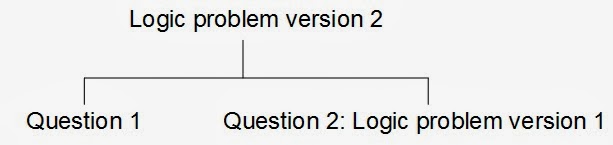
First you have used problem breakdown principle identifying that when the second question is asked, the situation must be similar to version 1 of the problem for you to get the right answer. This is somewhat like the figure below.


Note that, as you already know how to solve the version 1 of the problem, it has become easier for you to solve the problem version 2. What exactly did you know about the version 1 problem? You knew the problem description, problem modelling and process of reaching the solution. In short you have in your mind the concept structure for the version 1 of the problem. This is a clear example of using a concept structure in which you have used the concept structure of problem version 1 in solving the problem version 2.
What is the use of a concept structure in general? All knowledge is held in our mind in the form of concepts that are linked together in the form of concept structures. There are various forms of structures that we can use for representing the relationships between the concepts in a problem.
To formulate the first question then, you have used the techniques of Testing & Information discovery. You have discovered “more likely” as the key phrase in your first question.
Now is the time of enumeration. You have enumerated two scenarios and homed into the same promising form of question and action plan related to the answer.
Can you form the final form of the first question now?
I will leave you here to the pleasant experience of reaching the solution at last, after the seemingly interminable collection of statements.

Read my other blogs on Innovative idea generation and its basic principles and Get smart, get innovative usingTRIZ